

Table of Contents
Search engine optimization has changed a lot over the last few years. Google no longer ranks pages by looking at keywords alone. Today, it understands topics, user intent, entities, and the relationship between words. This shift has made Semantic SEO one of the most important parts of a successful SEO strategy.
If you still build content around one keyword and repeat it throughout the page, your strategy may not perform as well as before. Google now rewards content that answers a topic completely and satisfies what users actually want to know.
This guide explains the difference between Semantic SEO and Traditional SEO, how both approaches work, and why Semantic SEO has become essential for modern search rankings.
What Is Semantic SEO?
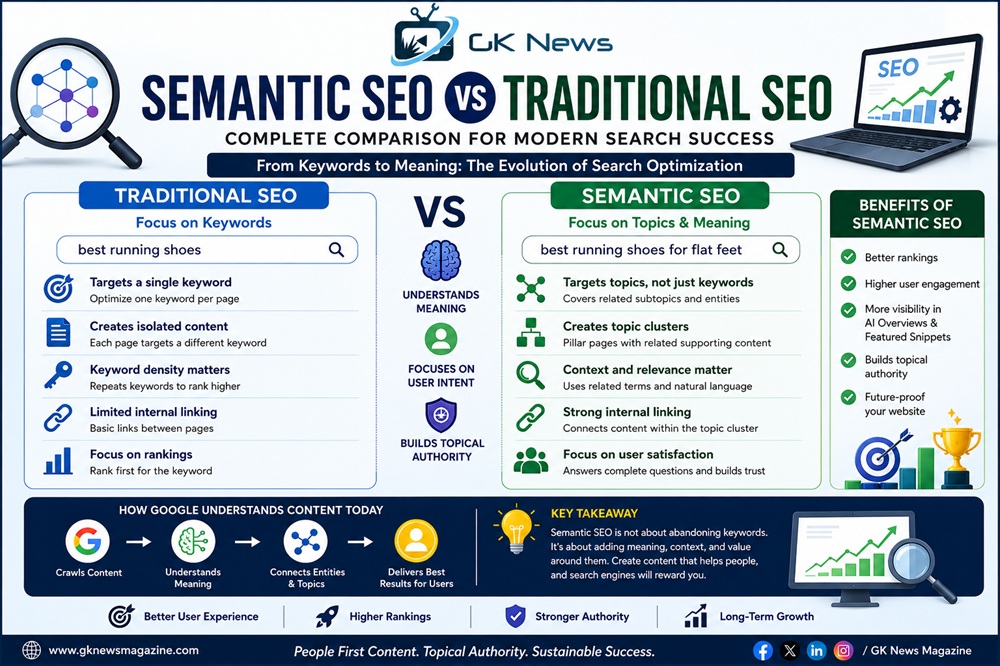
Semantic SEO is the practice of creating content that helps search engines understand the meaning and context of a topic instead of focusing on a single keyword.
It combines:
- Search intent
- Topic relationships
- Entities
- Internal linking
- Topical authority
- Natural language
Instead of optimizing one keyword, Semantic SEO builds complete topic coverage.
For example:
Traditional SEO targets:
Best Running Shoes
Semantic SEO also covers:
- Running shoe types
- Cushioning
- Stability shoes
- Trail running shoes
- Shoe sizing
- Running injuries
- Buying guide
- Frequently asked questions
Google understands that all these topics are connected.
What Is Traditional SEO?
Traditional SEO mainly focuses on optimizing individual keywords.
Older SEO strategies included:
- Exact keyword matching
- Keyword density
- Backlinks
- Meta tags
- Page titles
- URL optimization
While these elements still matter, they are no longer enough to achieve long term rankings.
Google’s ranking systems now evaluate whether a page provides complete, trustworthy, and helpful information for users.
Semantic SEO vs Traditional SEO
| Feature | Traditional SEO | Semantic SEO |
| Primary Focus | Keywords | Topics and user intent |
| Content Strategy | Single keyword pages | Comprehensive topic coverage |
| Search Understanding | Exact keywords | Meaning and context |
| Internal Linking | Basic | Topic clusters |
| User Intent | Limited | Primary ranking focus |
| Entities | Rarely used | Core optimization factor |
| Google AI Compatibility | Moderate | High |
| Future Ready | Limited | Excellent |
Why Google Prefers Semantic SEO
Google uses advanced language models and the Knowledge Graph to understand relationships between people, places, products, and concepts.
According to Google Search Central, Google’s ranking systems prioritize helpful, reliable, people first content that demonstrates experience, expertise, authority, and trust.
Instead of asking:
“Does this page contain the keyword?”
Google now asks:
- Does this page answer the user’s question?
- Does it explain the topic completely?
- Can users trust this information?
- Does it satisfy search intent?
This is exactly where Semantic SEO performs better.
Benefits of Semantic SEO
Better Rankings
Covering an entire topic increases topical relevance, which helps Google understand your expertise.
Improved User Experience
Readers should trust the information.
Experience
Visitors spend more time on pages that answer multiple related questions.
Higher AI Visibility
Semantic content has a better chance of appearing in:
- Google AI Overviews
- Featured Snippets
- Voice Search
- Answer Engines
Stronger Topical Authority
Publishing related articles around one subject helps build authority within your niche.
Better Internal Linking
Topic clusters naturally create meaningful internal links that improve crawling and user navigation.
Traditional SEO Still Matters
Traditional SEO is not outdated.
It still provides the technical foundation for every successful website.
Important elements include:
- Optimized title tags
- Meta descriptions
- Header tags
- Fast loading pages
- Mobile friendly design
- Image optimization
- Structured URLs
- XML sitemap
The difference is that these practices now support Semantic SEO instead of replacing it.
How to Build a Semantic SEO Strategy
Understand Search Intent
Before writing, identify what users really want.
Common search intents include:
- Informational
- Commercial
- Transactional
- Navigational
Content should match the intent behind the search.
Create Topic Clusters
Instead of publishing random articles, build content around one main topic.
Example:
Pillar Page
Semantic SEO Guide
Supporting Articles
- What Is Topical Authority
- Entity SEO Explained
- Internal Linking Best Practices
- Search Intent Guide
- Google AI Overviews Explained
- GEO vs SEO
- AEO vs SEO
Use Related Terms Naturally
Avoid repeating one keyword.
Instead, include related phrases like:
- Context
- Search meaning
- User queries
- Entities
- Knowledge Graph
- NLP
- Information retrieval
This helps search engines understand your content better.
Add Structured Data
Schema markup helps search engines understand page content.
Useful schema types include:
- FAQ
- Article
- Breadcrumb
- Organization
- Author
Build Helpful Internal Links
Link naturally to relevant content.
For example, readers interested in Semantic SEO may also find these topics useful:
- SEO Trends 2025: How AI is Changing Search Engine Optimization
- Unlocking SEO Success: Mastering Authority, Relevance and User Experience
- Google AI Overviews Launch
- Top 10 Benefits of SEO
- Ranking Signal and Ranking System
These articles fit naturally within the same SEO knowledge cluster.
Common Semantic SEO Mistakes
Many websites still make these mistakes:
- Writing only for keywords
- Ignoring search intent
- Publishing duplicate topics
- Weak internal linking
- Thin content
- No entity optimization
- Covering topics without expertise
Google recommends creating content primarily for people instead of search engines.
The Future of SEO
Search is becoming more intelligent every year.
Google AI Overviews, conversational search, and answer engines rely heavily on context instead of exact keyword matching.
Semantic SEO also supports:
- Generative Engine Optimization
- Answer Engine Optimization
- Voice Search
- AI powered search experiences
Businesses that build topical authority today will have a stronger chance of appearing in future search experiences.
Frequently Asked Questions
Is Semantic SEO better than Traditional SEO?
Yes. Semantic SEO provides broader topic coverage and aligns with how modern search engines understand content. Traditional SEO still supports technical optimization but should work alongside Semantic SEO.
Does Semantic SEO replace keyword research?
No. Keyword research remains important. Semantic SEO expands it by including related topics, entities, and user intent.
Can Semantic SEO improve Google AI Overview visibility?
Yes. Comprehensive, trustworthy, and well structured content has a better chance of being cited in AI generated search results.
What is the biggest difference between Semantic SEO and Traditional SEO?
Traditional SEO focuses mainly on keywords, while Semantic SEO focuses on meaning, context, and complete topic coverage.
Is Semantic SEO important for small businesses?
Yes. It helps businesses build topical authority, improve visibility, and compete with larger websites through high quality content.
Conclusion
Traditional SEO created the foundation of search optimization, but Semantic SEO represents the future. Google now rewards content that answers real questions, demonstrates expertise, and covers topics in depth rather than repeating keywords. The best strategy combines strong technical SEO with semantic optimization, user intent, and topical authority. By creating valuable content that genuinely helps readers, you build long term visibility and trust in search results. At GK News Magazine, we believe that people first content combined with Semantic SEO is the most sustainable way to succeed in modern search.