

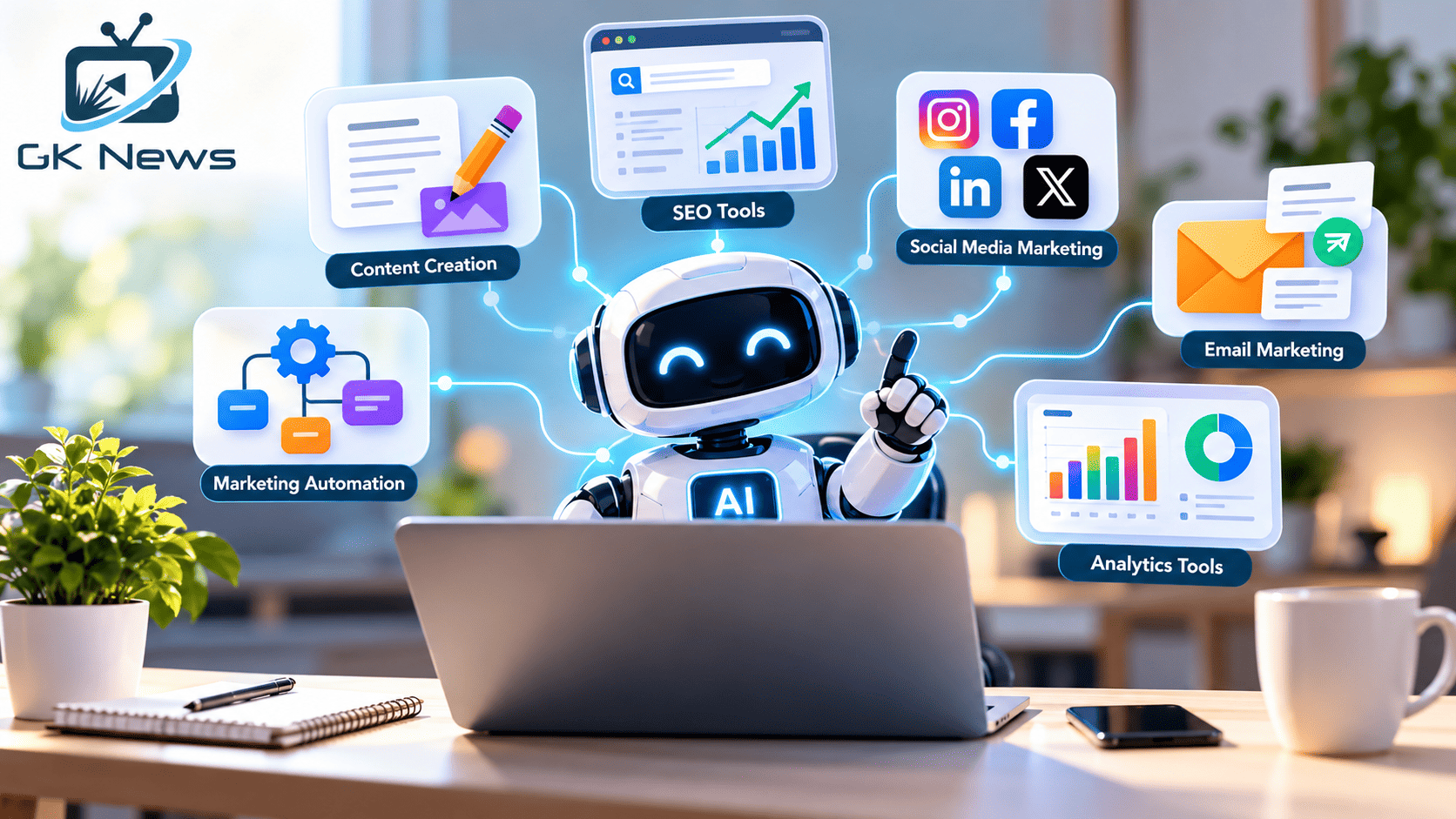
Digital marketers manage many tasks, from writing content and improving SEO to running email campaigns and tracking results. AI marketing tools can help teams complete these tasks faster, generate ideas, and make better use of campaign data.
The best AI marketing tools depend on your goals. ChatGPT can help with content and research. Canva supports visual content creation. Buffer helps with social media content. HubSpot brings AI features into marketing workflows, while SEO platforms help marketers research keywords and improve website performance.
However, no single tool can replace a sound marketing strategy. The right choice depends on your workflow, budget, audience, and business goals.
What Are AI Marketing Tools?
AI marketing tools use artificial intelligence to support tasks such as content creation, audience research, search engine optimization, email marketing, social media management, and data analysis.
These tools can generate drafts, summarize information, suggest ideas, analyze patterns, and automate selected tasks. Marketers can then review the output, apply their expertise, and make informed decisions.
For example, a small business can use AI to draft a product email, create social media captions, and review campaign results. A marketing team can use similar tools to organize research and prepare campaign variations.
7 AI Marketing Tools Every Digital Marketer Should Know
1. ChatGPT for Content Creation and Marketing Research
ChatGPT helps marketers brainstorm campaign ideas, draft content, refine messaging, summarize research, and analyze structured data. It can also adapt a core message for different channels.
Best for: Content marketers, freelancers, SEO specialists, and small businesses.
Practical example: A marketer can provide a product description and target audience, then request several blog outlines, email subject lines, and social media captions.
Main benefit: It supports many marketing tasks in one conversational interface.
Limitation: It can produce incorrect facts or weak recommendations. Verify claims, check sources, and edit every important output before publication.
Visit the official ChatGPT marketing guide for examples of marketing workflows.
2. Canva Magic Studio for Visual Content
Canva Magic Studio offers AI supported features for creating and editing visual content. Marketers can use these features to prepare social media graphics, presentations, campaign visuals, and other branded assets.
Best for: Social media managers, content creators, and small business owners.
Practical example: A marketer can prepare a campaign graphic, adapt its layout for different channels, and use AI writing support to draft accompanying copy.
Main benefit: It brings design and selected AI creation features into one workspace.
Limitation: AI generated visuals may contain errors or fail to match brand guidelines. Review text, layout, image rights, and brand consistency before publishing. Some features require a paid plan.
See the official Canva Magic Studio announcement for product information.
3. Semrush for SEO Research
Semrush helps marketers research keywords, analyze competitors, review backlinks, and assess website performance. Its product range also includes AI related SEO and content features, although access depends on the product and subscription.
Best for: SEO specialists, agencies, and businesses that rely on organic search.
Practical example: An SEO professional can identify relevant search terms, compare competing pages, and build a content plan around gaps in existing coverage.
Main benefit: It combines several SEO research tasks within one platform.
Limitation: Keyword metrics and recommendations need context. Search volume does not guarantee traffic, and a higher keyword difficulty score does not tell the whole story. Check search intent and the quality of competing pages before choosing a topic.
Visit the official Semrush website to review its current SEO products and plans.
4. HubSpot for AI Marketing Automation
HubSpot combines customer relationship management with marketing tools. Its AI features support content creation and selected marketing workflows within the platform.
Best for: Growing businesses, marketing teams, and companies that manage customer journeys across several channels.
Practical example: A team can draft campaign content, organize customer information, and coordinate marketing activities within its existing HubSpot workflow.
Main benefit: It connects marketing activities with customer records and campaign management.
Limitation: Available features depend on the subscription, account settings, and usage limits. Businesses should compare the full cost and setup requirements before adopting the platform.
Read the official HubSpot content agent documentation for current feature details.
5. Buffer AI Assistant for Social Media
Buffer AI Assistant helps marketers generate social media ideas, draft captions, and rewrite content for different channels. Marketers can use it alongside Buffer’s publishing tools.
Best for: Freelancers, creators, small businesses, and social media managers.
Practical example: A marketer can turn a blog article into a LinkedIn post, shorten the message for another channel, and prepare variations for review.
Main benefit: It supports content preparation within a social media publishing workflow.
Limitation: AI generated posts may sound generic or miss important context. Review every caption, adapt it to the platform, and check the current feature availability for your plan.
See the official Buffer AI Assistant guide.
6. Mailchimp for Email Marketing
Mailchimp offers email marketing and automation features, with AI supported capabilities available for selected tasks and plans. Marketers can use its platform to manage subscribers, prepare campaigns, and measure email performance.
Best for: Small businesses, ecommerce teams, and email marketers.
Practical example: A business can draft a promotional email, test different subject lines, and review engagement metrics to understand which message performs better.
Main benefit: It brings email campaign management and reporting into one platform.
Limitation: Feature availability and costs depend on the plan. AI suggestions cannot guarantee higher open rates or sales. Follow consent rules, protect subscriber data, and monitor campaign performance.
Visit the official Mailchimp website to review its current email marketing features and pricing.
7. Google Analytics 4 for Marketing Analytics
Google Analytics 4 helps marketers understand how people interact with a website or app. Its reporting and analytics features can support campaign evaluation, audience analysis, and conversion tracking.
Best for: Digital marketers, website owners, performance marketers, and analysts.
Practical example: A marketer can compare traffic sources, examine landing page engagement, and measure whether campaigns lead to meaningful actions.
Main benefit: It helps connect marketing activity with measurable website outcomes.
Limitation: Analytics results depend on correct tracking, suitable event configuration, and careful interpretation. Do not assume every automated insight is a proven explanation for a change in performance.
Visit Google Analytics and the Google Analytics Help Center for setup and reporting guidance.
AI Marketing Tools Comparison Table
| Tool | Main use | Best suited for | Key consideration |
|---|---|---|---|
| ChatGPT | Content and research | General marketing teams | Verify facts and sources |
| Canva Magic Studio | Visual creation | Designers and social teams | Review brand consistency |
| Semrush | SEO research | SEO professionals | Interpret metrics carefully |
| HubSpot | Marketing workflows | Growing businesses | Check subscription costs |
| Buffer | Social media content | Creators and small teams | Review channel specific copy |
| Mailchimp | Email campaigns | Email marketers | Follow consent requirements |
| Google Analytics 4 | Performance analysis | Analysts and website owners | Check tracking accuracy |
These tools serve different purposes. Some focus on creating content, while others help manage campaigns or measure results. Compare current features and prices on each provider’s official website before purchasing.
How Should You Choose the Right AI Marketing Tools?
Follow these five steps to make a practical choice.
- Identify your main problem. Decide whether you need help with SEO, content, social media, email, automation, or analytics.
- Choose a tool for that task. Start with one tool that directly addresses your biggest need rather than buying several overlapping subscriptions.
- Check the total cost. Review free plan limits, paid features, usage caps, integrations, and any extra costs.
- Test it with a real task. Use an actual campaign brief or workflow. Measure time saved, output quality, and the amount of editing required.
- Review the results. Keep the tool if it improves your work without reducing accuracy, brand quality, or customer trust.
Are Free AI Marketing Tools Enough?
Free AI marketing tools can suit beginners, students, freelancers, and small businesses. They often provide enough functionality to test a workflow before committing to a subscription.
However, free plans may limit usage, integrations, storage, collaboration, or advanced features. Some platforms offer free access to basic tools while charging for specific AI features.
Start with the free options that fit your needs. Upgrade only when a paid feature solves a clear problem or provides measurable value.
Common Mistakes to Avoid When Using AI for Marketing
AI can improve productivity, but careless use can harm content quality and customer trust.
- Publishing without review: Check facts, links, spelling, and tone before publishing.
- Using generic content: Add original analysis, examples, and information that helps your audience.
- Ignoring customer privacy: Do not upload confidential customer information or sensitive business data without checking the tool’s data policies and your organization’s rules.
- Automating every decision: Keep human oversight for strategy, brand messaging, customer complaints, and important campaign decisions.
- Measuring activity instead of results: Track meaningful outcomes such as qualified leads, conversions, revenue, and customer retention where relevant.
Google’s guidance focuses on helpful, reliable, people first content, regardless of whether a person uses AI to create it. Using automation primarily to manipulate search rankings can violate Google’s spam policies. Read Google’s guidance on AI generated content before using AI extensively in SEO content production.
Frequently Asked Questions
What are the best AI marketing tools for beginners?
ChatGPT, Canva, and Buffer are useful starting points for content creation, visual design, and social media tasks. Choose based on your needs and check the current free plan limits before signing up.
Can AI marketing tools improve SEO?
Yes. AI tools can help with keyword research, content planning, topic analysis, and content editing. However, they cannot guarantee better rankings. Strong SEO also requires useful content, technical accessibility, relevant links, and a good understanding of search intent.
Are free AI marketing tools available?
Yes. Several providers offer free plans or limited free access. The available features, usage limits, and eligibility vary by provider. Review the official pricing page before choosing a tool.
Can AI automate digital marketing?
AI can support parts of digital marketing, including content drafting, email workflows, social media preparation, and data analysis. However, marketers should monitor automated actions, review outputs, and maintain human oversight.
Which AI marketing tools are best for small businesses?
ChatGPT, Canva, and Buffer can help small businesses with content and social media tasks. Google Analytics 4 can help measure website performance. Businesses with more complex customer journeys may also consider HubSpot or Mailchimp.
Does Google penalize AI generated content?
Google does not automatically penalize content simply because someone used AI to create it. Google focuses on quality and whether content helps people. Using automation primarily to manipulate search rankings can violate Google’s spam policies. See Google’s official AI content guidance.
Final Thoughts
AI marketing tools can help digital marketers create content, manage campaigns, improve SEO research, and understand performance. The best results come from matching each tool to a clear business need and checking its output with human judgment.
Start with the tasks that consume the most time. Test suitable tools, measure their impact, and invest in features that improve your workflow. For more practical insights into AI, SEO, and digital marketing, GK News Magazine provides readers with technology guides and marketing related articles to support informed decisions.