

Table of Contents
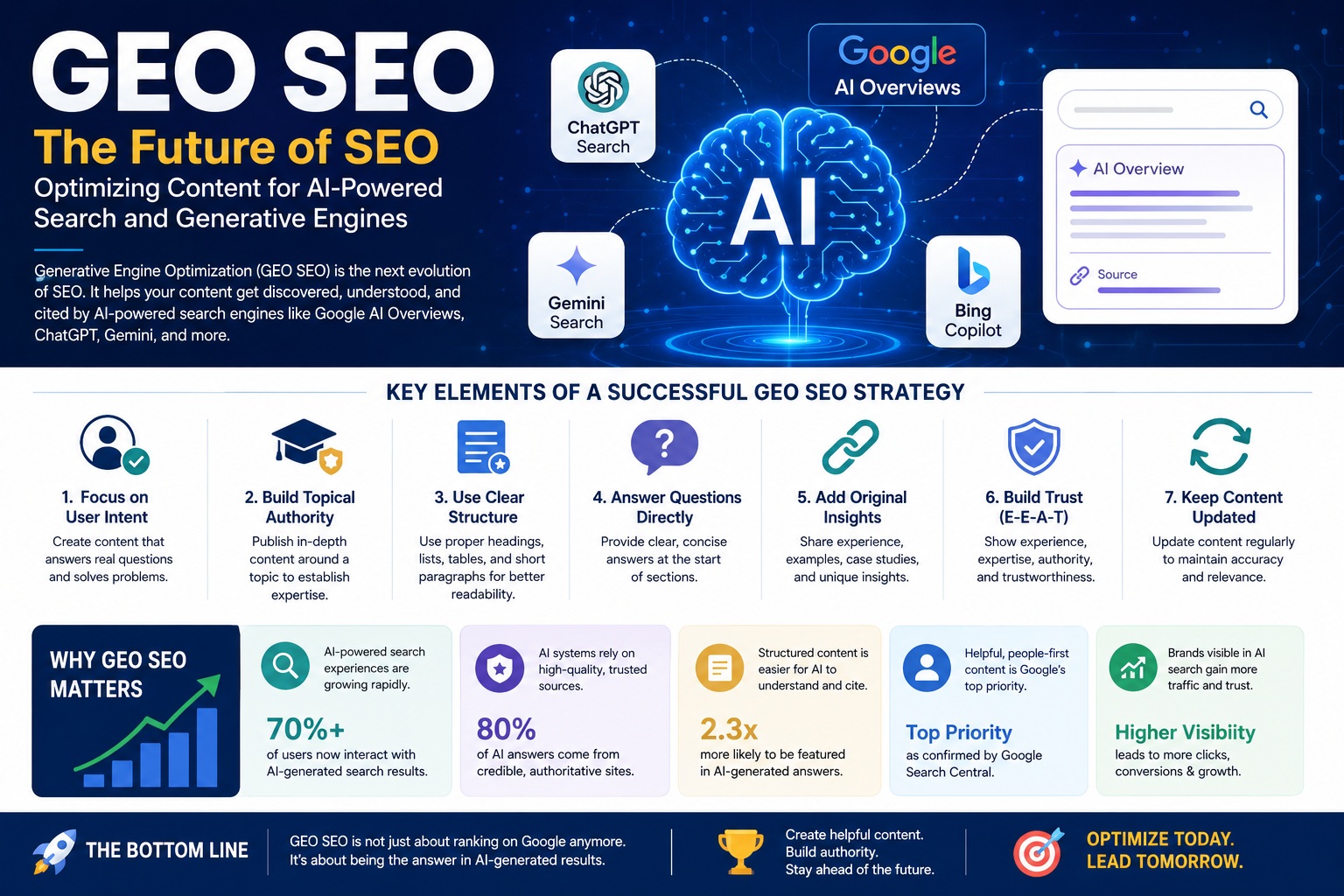
Search is changing faster than ever. People no longer rely only on traditional Google search results. Today, millions of users ask questions in Google AI Overviews, ChatGPT, Gemini, Perplexity, and Microsoft Copilot. Instead of showing only a list of web pages, these platforms generate complete answers using trusted online sources.
This shift has created a new opportunity for businesses, publishers, and marketers. Your goal is no longer limited to ranking on the first page of Google. You also want AI platforms to select, understand, and reference your content when answering user questions.
This is where GEO SEO, also known as Generative Engine Optimization, becomes important.
GEO SEO builds on traditional SEO. It helps search engines and AI systems understand your content through better structure, factual accuracy, topical depth, semantic relevance, and trust. Google continues to recommend creating helpful, reliable, people first content because its ranking systems reward quality regardless of how the content is produced.
If you want your website to stay visible in the future of search, GEO SEO should become part of your content strategy.
What is GEO SEO?
Generative Engine Optimization (GEO SEO) is the process of creating and organizing content so AI powered search engines can understand, trust, summarize, and cite it in generated answers.
Unlike traditional SEO, which focuses mainly on search rankings, GEO SEO focuses on becoming a reliable source that AI systems use when answering questions.
Modern AI search platforms analyze content differently. They look for:
- Clear explanations
- Reliable facts
- Topic expertise
- Strong context
- Logical content structure
- Trustworthy sources
- Semantic relationships between ideas
When your content meets these expectations, it has a better chance of appearing inside AI generated answers instead of only ranking as a blue link.
Why GEO SEO Matters
Artificial intelligence is changing how people search online.
Instead of typing:
“Best SEO strategy 2026”
Many users now ask:
“How can I improve my website visibility in AI search?”
AI search engines provide instant answers. They often summarize information from several trusted websites.
This means websites that provide complete, well structured information can gain visibility even if they are not ranked first organically.
Benefits of GEO SEO include:
- Better visibility in AI generated answers
- More brand authority
- Higher trust among users
- Increased organic traffic
- Better user engagement
- Improved topical authority
- Future ready SEO strategy
SEO vs GEO SEO
| Traditional SEO | GEO SEO |
| Focuses on search rankings | Focuses on AI generated answers |
| Targets keywords | Targets topics and user intent |
| Optimizes webpages | Optimizes knowledge and context |
| Relies on backlinks | Relies on trust and authority |
| Measures ranking position | Measures citations and visibility in AI answers |
| Focuses on Google Search | Focuses on Google AI Overviews, ChatGPT, Gemini, Perplexity, Copilot and similar platforms |
Both strategies work together. GEO SEO does not replace SEO. It strengthens it.
How Generative AI Search Engines Understand Content
Modern AI systems do much more than match keywords.
They evaluate:
Content Quality
The content should answer the user’s question completely.
Expertise
Readers should trust the information.
Experience
Real examples improve credibility.
Authority
Trusted websites receive more attention.
Structure
Clear headings help AI understand topics.
Context
Related information helps AI connect ideas.
Semantic Meaning
AI understands concepts instead of repeating keywords.
Google recommends creating original, helpful, people first content that demonstrates experience, expertise, authoritativeness, and trustworthiness.
Key Elements of a Successful GEO SEO Strategy
A strong GEO SEO strategy starts with useful content. It also requires proper organization, technical optimization, and continuous updates. Here are the most important elements.
1. Write for User Intent First
Every article should answer a specific question or solve a real problem.
For example, instead of writing only about SEO, create content that answers questions such as:
- What is GEO SEO?
- How does GEO SEO work?
- Is GEO better than traditional SEO?
- How can small businesses use GEO SEO?
When readers find complete answers, AI systems can also understand the page more easily.
2. Build Topical Authority
AI search engines trust websites that publish multiple high quality articles on the same topic.
Instead of writing one article about GEO SEO, create supporting articles such as:
- GEO SEO Best Practices
- GEO SEO vs AEO
- GEO SEO vs Traditional SEO
- How Google AI Overviews Choose Sources
- How ChatGPT Finds Reliable Information
- Schema Markup for AI Search
- How to Optimize Content for AI Overviews
A group of related articles signals expertise and strengthens your authority.
3. Use Clear Content Structure
AI models understand well organized pages much better than pages with large blocks of text.
Follow this structure:
- One H1 heading
- Logical H2 sections
- Supporting H3 headings
- Short paragraphs
- Numbered lists
- Bullet points
- Tables where useful
This format also improves the reading experience.
4. Answer Questions Directly
Many AI generated answers come from content that provides short and clear responses.
Start important sections with a direct answer.
Example:
What is GEO SEO?
GEO SEO is the practice of optimizing content so AI powered search engines can understand, summarize, and reference it in generated responses.
After the direct answer, explain the topic in greater detail.
5. Add Original Insights
AI search engines prefer content that adds value instead of repeating information available everywhere.
Ways to make content more useful include:
- Share practical experience
- Include case studies
- Add real examples
- Compare different approaches
- Explain mistakes to avoid
- Include expert opinions
Original information increases trust and encourages AI systems to reference your content.
GEO SEO Best Practices Checklist
| Best Practice | Why It Matters |
| Focus on search intent | Answers real user questions |
| Use clear headings | Helps AI understand content |
| Add original examples | Improves authority |
| Support facts with trusted sources | Builds trust |
| Keep content updated | Maintains relevance |
| Cover topics in depth | Builds topical authority |
| Use semantic keywords naturally | Improves contextual understanding |
| Optimize page speed | Enhances user experience |
| Use schema markup | Helps search engines interpret content |
| Link related articles | Strengthens topic relationships |
Common GEO SEO Mistakes
Many websites still optimize only for traditional search results. This limits their visibility in AI powered search.
Avoid these common mistakes:
Keyword Stuffing
Repeating the same keyword many times reduces readability and adds little value.
Thin Content
Short pages with little information rarely become trusted sources.
No Supporting Evidence
Back up important facts with reliable research, official documentation, or industry studies.
Poor Content Structure
Long paragraphs without headings make it harder for both readers and AI systems to understand the page.
Ignoring Search Intent
A page should solve the visitor’s problem instead of focusing only on keywords.
Publishing Without Updates
Search and AI technologies evolve quickly. Regular updates keep your content accurate and useful.
Statistics That Show Why GEO SEO Matters
| Statistic | Source |
| Google continues to prioritize helpful, reliable, people first content in its ranking systems. | Google Search Central |
| AI powered search experiences are becoming a major part of how users find information online. | Google AI Overviews documentation |
| Large language models rely on high quality, authoritative sources when generating responses. | Microsoft Research |
| Structured content with clear headings improves information extraction by AI systems. | Google Search Central |
These trends show that websites must optimize not only for search rankings but also for AI generated answers to remain competitive.
Statistics That Show Why GEO SEO Matters
Google AI Overviews summarize information from trusted websites to answer user questions quickly. Although Google does not publish a separate ranking algorithm for AI Overviews, it recommends creating helpful, reliable, people first content that demonstrates strong E E A T signals.
If you want your content to appear in AI generated summaries, follow these best practices.
Write a Strong Introduction
The first paragraph should explain the topic clearly.
For example:
Generative Engine Optimization, also called GEO SEO, is the process of optimizing content so AI powered search engines can understand, summarize, and cite it in generated answers. It combines traditional SEO with structured content, topical authority, semantic relevance, and trust.
This type of introduction helps both readers and AI systems understand your page immediately.
Answer Important Questions Early
Many AI platforms extract short answers from the beginning of sections.
Instead of writing long introductions, provide a clear answer first and then explain it.
Example:
How does GEO SEO work?
GEO SEO improves content quality, structure, authority, and context so AI search engines can confidently reference it in generated responses.
Use Semantic Keywords Naturally
Modern search engines understand related concepts instead of matching only exact keywords.
For this article, naturally include phrases such as:
- Generative Engine Optimization
- GEO marketing
- AI search optimization
- AI SEO
- AI search engines
- Google AI Overviews
- Answer Engine Optimization
- AEO
- Search Generative Experience
- ChatGPT search
- Gemini Search
- Bing Copilot
- Semantic SEO
- Entity SEO
- Search intent
- E E A T
- Helpful Content
- Topical authority
Avoid forcing keywords into every paragraph.
Support Facts with Trusted Sources
AI systems prefer content supported by reliable references.
Good sources include:
- Google Search Central
- Google Developers
- Microsoft Research
- Stanford University
- MIT
- Government websites
- Peer reviewed research
- Industry reports
Reliable citations improve credibility and user trust.
Why E E A T Is Critical for GEO SEO?
Google emphasizes Experience, Expertise, Authoritativeness, and Trustworthiness when evaluating content quality. Trust remains the most important element because it helps users rely on the information they read.
You can strengthen E E A T by:
- Publishing original research
- Sharing practical experience
- Using accurate statistics
- Updating outdated information
- Adding author information
- Linking to trusted sources
- Maintaining factual accuracy
Strong E E A T also increases the likelihood that AI systems will reference your content.
Frequently Asked Questions
What is GEO SEO?
GEO SEO is the process of optimizing content so AI powered search engines can understand, summarize, and cite it in generated answers.
Is GEO SEO replacing traditional SEO?
No. GEO SEO complements traditional SEO. Strong technical SEO and high quality content remain essential for long term success.
How is GEO different from AEO?
Answer Engine Optimization focuses on providing direct answers for search engines and voice assistants. GEO SEO has a broader goal of making content useful for generative AI systems that create complete responses.
Does schema markup help GEO SEO?
Yes. Structured data helps search engines understand your content more clearly. While schema alone does not guarantee AI citations, it supports better content interpretation.
Can small websites rank in AI search?
Yes. Smaller websites can earn AI citations if they publish original, accurate, and comprehensive content that demonstrates expertise and trust.
How often should GEO SEO content be updated?
Review important articles every three to six months or whenever major industry changes occur. Updated content stays relevant for both users and AI search systems.
Conclusion
Search is moving beyond traditional rankings. Users increasingly rely on AI powered search experiences that provide direct, conversational answers. Businesses that publish accurate, well structured, and trustworthy content will be in the strongest position to gain visibility across Google AI Overviews, ChatGPT, Gemini, Perplexity, and other emerging platforms.
GEO SEO is not a replacement for traditional SEO. It is the next step in content optimization. By focusing on helpful information, topical authority, semantic relevance, and E E A T principles, you can improve your chances of becoming a trusted source for both search engines and AI systems.
As AI continues to shape the future of search, publishers who invest in high quality, people first content will build lasting visibility and authority. GK News Magazine remains committed to sharing practical SEO strategies, digital marketing insights, and technology updates that help readers succeed in this new era of search.